Wet cupping — performed only by a doctor
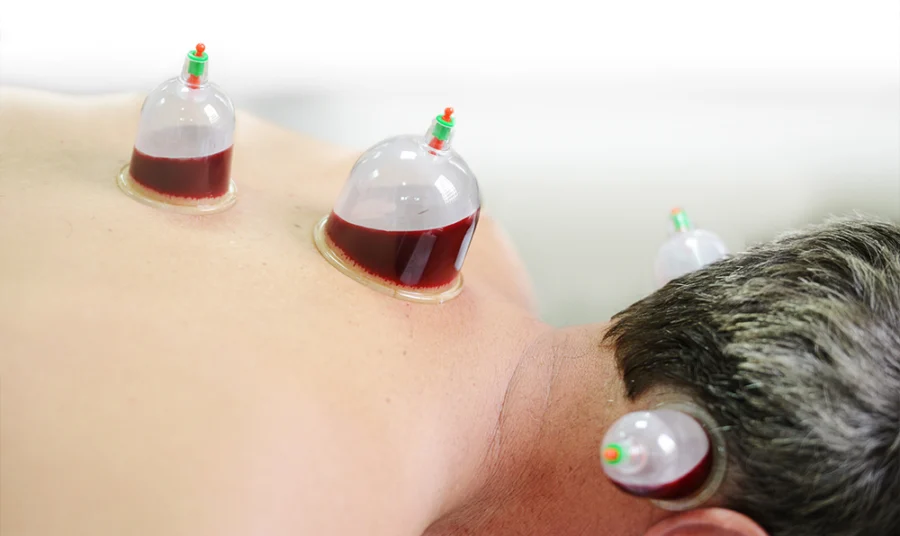
Suction is applied, then very small controlled incisions are made and the cups reapplied to draw out a small quantity of stagnant blood. This is an invasive procedure and we treat it as one — it is performed only by Dr. Saeedul Hasan Siddiqui, B.I.M.S., never by an assistant, and only after his own assessment.
What a wet cupping session involves
The skin is cleaned, dry cupping is applied first, then superficial incisions are made with a fresh single-use blade before the cups are reapplied for a few minutes. The site is cleaned and dressed afterwards.
- Performed by Dr. Siddiqui, not by an assistant
- Fresh, single-use blades and cups for every patient
- Sealed instruments opened in front of you
- Gloves worn throughout; clinical waste disposed of separately
- Incisions are superficial — they do not require stitches
- Site cleaned and dressed, with written aftercare
Suction, then a small controlled incision
Wet cupping (hijama) begins the same way as dry cupping — suction is applied to the skin — but a fresh single-use blade is then used to make very small, superficial incisions, and the cup is reapplied to draw out a small quantity of stagnant blood. It is an invasive procedure, which is why it is performed only by Dr. Saeedul Hasan Siddiqui himself, and only after he has assessed you. Not every patient needs it — many are treated with dry cupping alone, and he will tell you honestly which is appropriate for your condition.
Who may benefit
Wet cupping may be considered for these when dry cupping alone is unlikely to be enough — we say “may be considered” deliberately, since it is always decided case by case, not promised in advance.
Often used on the upper back when tension there sits behind the attacks.
Joint and muscular pain that has not settled with dry cupping alone.
Such as persistent acne, on the back rather than the face.
Patients seeking treatment within the Unani tradition, alongside herbal remedies where appropriate.
Conditions we use it for
Cupping at the upper back, shoulders and head points is used to relieve the muscular tension and circulatory c…
Learn moreTargeted cupping around the knee to reduce inflammation and swelling, ease stiffness on stairs and after sitti…
Learn moreUsed to reduce the inflammation behind acne and support the body’s own clearing processes, usually alongside U…
Learn moreDry cupping vs. wet cupping
| Dry cupping | Wet cupping | |
|---|---|---|
| Skin | Suction only, no cuts | Suction plus small superficial incisions |
| Blood | None drawn | A small, controlled quantity drawn |
| Who performs it | Trained therapist under Dr. Siddiqui’s supervision | Dr. Siddiqui personally, always |
| Invasiveness | Non-invasive | Invasive procedure |
| Suitability | Suitable for most patients | Not suitable for everyone — assessed case by case |
| Aftercare | Clean and dry for 24 hours | Clean and dry for 24 hours, dressed incision site |
Many patients are treated with dry cupping alone. Dr. Siddiqui recommends wet cupping only when he judges it more appropriate for your specific condition — not as a routine upgrade.
- The initial suction — a firm pulling sensation, the same as dry cupping
- A brief scratching sensation as the small incisions are made
- Warmth during the second suction, then a small dressing applied
- Possible tenderness at the site for a day or two afterwards
- Improved local circulation at the treated site
- Temporary relief of muscular tightness
- May be combined with Unani herbal treatment
- An individualised plan, not a fixed package
We describe these as potential, not guaranteed. Response varies between patients.
Potential risks and side effects
Wet cupping is an invasive procedure. Being clear about what can go wrong — not just what it may help — matters more than any marketing claim we could make.
- Temporary bruising and marks around the treated area
- Tenderness at the site for a day or two
- Light-headedness during or shortly after the session — if this happens, we stop
- Skin irritation where the cup sealed against the skin
- Infection is a recognised risk of any procedure that breaks the skin — our single-use, sterile-technique protocol below exists specifically to minimise it
What to do afterwards
- Keep the dressing clean and dry for 24 hours
- Drink plenty of water and rest
- Follow the written aftercare you are given before you leave
- Swimming, the gym or sauna for 48 hours
- Scratching or picking at the incision site
- Heavy lifting or intense exercise
How we keep it safe
- Fresh, single-use disposable cups and blades for every patient — nothing that contacts skin is reused.
- Sterilised, sealed instruments opened in front of you.
- Treatment surfaces cleaned and re-covered between patients.
- Clinical waste disposed of separately, not in general refuse.
- Gloves worn for all wet cupping procedures.
- You take blood thinners (warfarin, heparin, clopidogrel) or have a bleeding or clotting disorder.
- You are pregnant — several cupping points are avoided entirely in pregnancy.
- There is an active skin infection, eczema flare or open wound at the treatment site.
- You have uncontrolled diabetes, severe anaemia, or are undergoing chemotherapy.
- You have had surgery in the area recently.
- You are under 12, unless referred by your doctor.

Dr. Saeedul Hasan Siddiqui
B.I.M.S. from Jamia Hamdard, New Delhi (1981), registered with the Delhi Bhartiya Chikitsa Parishad under the Ministry of AYUSH framework. He has practised hijama cupping in Delhi-NCR for over 40 years. Because wet cupping is invasive, he performs every wet cupping procedure himself, after his own consultation — it is never delegated to a therapist.
Current evidence and our clinical approach
Clinical research into wet cupping is still evolving. Some studies suggest potential benefit for selected musculoskeletal conditions, while evidence for many other conditions remains limited or inconclusive, and there are no large trials establishing it as a cure. Because of this, treatment recommendations at our clinic are based on an individual medical assessment rather than a standard package — and where wet cupping is not the appropriate choice, we will tell you and recommend dry cupping or another approach instead.
Wet cupping — your questions
How much blood is drawn?
A small quantity — far less than a blood donation. If you feel light-headed the session is stopped.
Does it hurt?
The incisions are usually described as a brief scratch. The suction that follows is the same firm pull as dry cupping.
Is it safe if I take medication?
Blood thinners are an absolute reason we decline. Tell Dr. Siddiqui about every medication you take, including anything over the counter.
How long does healing take?
The small incisions close within a day or two. Keep the area clean and dry for 24 hours, and avoid swimming and the gym for 48.
What is the difference between wet and dry cupping?
Dry cupping is suction only, with no cuts and no blood drawn. Wet cupping adds small superficial incisions to draw out a small quantity of blood, and is performed only by Dr. Siddiqui. See the comparison table above, or our dry cupping page.
Will I need stitches?
No. The incisions are superficial and close on their own within a day or two, without stitches.
Can I shower afterwards?
Keep the treated area clean and dry for the first 24 hours, so a careful shower avoiding the dressing is fine; avoid soaking it in a bath, pool or sauna in that time.
Can I drive home and go back to work?
Most patients drive themselves home and return to normal daily activity the same day. Avoid the gym, swimming or heavy lifting for 48 hours.
Can diabetics have wet cupping?
If your diabetes is well controlled, tell Dr. Siddiqui at the consultation and he will assess whether it is appropriate. Uncontrolled diabetes is one of the conditions we decline to treat, because a procedure that breaks the skin needs healing to work normally. See our safety policy.
Can I take painkillers or continue my medication?
Tell Dr. Siddiqui about every medication you take, including anything over the counter, before your session. Blood thinners are an absolute reason we decline to treat.
When should I contact the clinic after treatment?
Call us if you notice a fever, spreading redness, heat, persistent bleeding or discharge from the site. Phone support is included after every session at no charge.
Not sure if hijama is right for you?
The first consultation is free and there is no obligation to book. Ask Dr. Siddiqui directly about your condition.